
Search for Washington Residents
Washington has no master list of residents. Start with the county tied to the address or event, then choose a source that answers one narrow question. The State Treasurer’s county directory routes an address to its assessor and treasurer; court, voter, vital, archive, and business records each have a different keeper. A name-only hit is a lead. Compare county, dates, middle initials, and the type of address shown before joining records that may belong to different people.
A practical first pass moves from a likely place to a record that can be checked with its custodian. Keep the search personal and lawful. Public rolls do not include every household member, and Washington’s protected-address program can keep a person out of ordinary public voter lists.
- Use the county assessor directory to identify the property office for the address, then check the parcel by address or owner name.
- Use VoteWA only for the voter’s own registration; a separate voter-file request follows public-use limits.
- Search the relevant court index or business filing system when the name has a known case or organization link.
- For an earlier household, check the State Library catalog, local library, and archive records for that place and year.
- If a public record is missing online, ask the office that holds it for an existing file or older index.
Where Washington Resident Records Begin
State offices maintain statewide products and indexes, but county offices keep much of the property, deed, election, and court material. The correct custodian depends on the county where an address, filing, or life event belongs. State Archives branches preserve selected local-government series; their county coverage helps route older questions.
These offices offer different access paths. Use the public portal when it fits, then follow its instructions for an in-person terminal, phone or mail request, or archive referral. A statewide index may point to a record without holding the complete file.
Washington State Archives
State records in Olympia; county and local series are assigned to five regional branches.
Digital Archives search and the branch list identify online and in-person routes.
Department of Health
The Center for Health Statistics handles statewide birth, death, fetal-death, marriage, and divorce certificates.
Review product and ordering channels before submitting an application.
Secretary of State Elections
VoteWA serves a registered voter checking their own record. County auditors handle local election administration.
Open VoteWA or consult the voter-data request rules for public lists.
Washington County Property Rolls
Washington has 39 county assessor systems rather than one statewide property search. The State Treasurer’s county assessor and treasurer directory is the statewide starting point. Search the county tied to the physical parcel, not only the postal city. Some county portals allow owner-name searches; others rely more on address, parcel number, or a map.
An assessor entry connects a taxpayer to a parcel for tax purposes. It can show a site address, a separate mailing address, a legal description, assessed value, and property details, depending on the county. It does not establish who lives inside. A trust, business, or relative may receive the tax bill, and a parcel can contain more than one unit. For recorded ownership, carry the parcel number or legal description to the county auditor or recorder. Its name index and document copies are separate from the assessor roll.
- Parcel
- A county’s mapped and numbered piece of land, often linked to an assessor account.
- Situs address
- The physical location of the parcel, which may differ from the tax mailing address.
- Legal description
- The survey, plat, lot, or boundary wording that identifies land in a recorded document.
Search Washington Archives Catalogs
The State Archives offers a useful first check for older government records. Its Digital Archives search asks for at least one search term after the site loads and provides fields for record series, county, and title. County selection matters: Washington’s historical series are distributed among branches and local custodians, and not every catalog result has a digitized image.
The broader collections catalog describes non-digital holdings and routes researchers to the branch that serves the county. Search the name of the series as well as the person or place. Then ask the holding branch about reference help, copies, and any on-site material that is not in the online result.
| Search field | What to enter | How it helps |
|---|---|---|
| Record Series | Known series or record type | Narrows the catalog to a group of related records. |
| County | The county tied to the record | Routes a local series toward the correct branch or office. |
| Title | Person, place, office, or collection title | Finds a named entry or a catalog heading. |
Present-Day Washington Resident Directory Sources
Modern Washington resident records are narrow rolls maintained for different purposes. People who search a Washington residents directory may be looking for an owner, a registered voter, a court party, or a past household. The table separates those leads and marks where each one stops. Every source has its own access rules and dates.
| Record | What It Can Show | Custodian | Boundary |
|---|---|---|---|
| Assessor roll | Taxpayer and parcel details | County assessor | Owner is not necessarily an occupant. |
| Voter record | Public fields for registered voters | State and county elections offices | Use limits apply; protected voters are omitted. |
| Court index | Party, case number, court, and filing lead | Washington Courts and filing court | The index is not the complete case file. |
| Business filing | Entity name, office address, agent, and filings | Secretary of State | A business address is not proof of residence. |
| Historical directory | Printed name and address for a past year | State or local library and archives | Year runs have gaps and are not current. |
Pick the source that matches the question, then check its dates and custodian. A name in a deed, a case index, or a directory is not a current-person confirmation. The Washington resident lookup page covers the one-person verification sequence and the limits on common-name matches.
Check Washington Court Results
Washington Courts Search offers person, case, attorney, and hearing-date routes across municipal, district, superior, and appellate indexes. The index is updated about every 24 hours. It is a reference tool, not the official court file, and the statewide page warns that identity, status, and docket details may be incomplete or out of date.
Use the result to identify a court and case number, then contact the court of record for the docket or document copies. Many superior courts use Odyssey, while some counties have separate systems. Local clerks can explain public terminals, older-file retrieval, copy methods, and fees. Sealed and otherwise restricted records do not become public because a name search returns a nearby case.
A court-search result may show these fields, though the statewide index warns that some details and documents may not display:
- Party name and role, such as petitioner or respondent
- Case number, court name, and court level
- Case type and filing year or date, where returned
- Docket link and any displayed status or disposition
- Document links when the local court system supplies them
Washington Vital Record Access
The Department of Health’s Center for Health Statistics is the statewide source for current Washington birth, death, fetal-death, marriage, and divorce certificates. Product rules depend on the event and the copy requested. A noncertified informational birth copy is open for personal and genealogy use; certified copies of covered records require the listed identity and relationship documents. A product page explains current application fields, ordering routes, and fees.
Historical access follows separate opening periods. Birth and fetal-death records move to State Archives after 100 years; death, marriage, and divorce records after 25 years. Marriage and divorce certificates from 1968 forward are ordered through DOH, while a full divorce case file belongs to the superior-court clerk. DOH does not offer a free phone-only verification search. Ask the health jurisdiction or archive about local and older registers when the statewide product does not fit.
Washington State Archives by Region
State Government Archives in Olympia holds state-level material. Five regional branches in Bellevue, Bellingham, Cheney, Ellensburg, and Olympia hold selected local-government records by county. A local deed, court index, election series, or municipal file may remain with its county or city, so check both the current custodian and the branch serving that place.
Search the digital catalog first, then use the collections catalog and branch map to find paper, microfilm, or transferred series. Branch coverage and copy rules depend on the collection. Local libraries and historical societies can also hold newspapers, yearbooks, obituaries, photographs, and city directories that are not state records.
Historic Washington Resident Directories
The Washington State Library describes city and county directories dating from 1890 to the present across 35 counties and 300 cities, with gaps in individual runs. Its online catalog lists on-site holdings. Since July 2025 the Tumwater facility has been closed to ordinary public access, with limited Thursday appointments; a local library or historical society may offer another shelf or reference route.
Older volumes can place a name, occupation, and street address between census years. Street-order sections may identify an adult listed at a house, but the front matter must be checked for abbreviations and symbols. The full collection guide and household-tracing method are on the Washington city directory page.
Washington’s archive history also helps explain why a blank online result is not the end of the trail. A 1951 partnership between the State Library and Archives began microfilming archival newspapers and manuscripts. A paper index or microfilm reel may still hold a clue that was never digitized.
Washington Business Filing Clues
The Secretary of State’s Corporations and Charities Filing System searches public business records by name or UBI, the state business identifier. A result can show an entity’s status, principal office and mailing addresses, registered agent, formation dates, and filing history. An address attached to a business is an affiliation clue, not proof that a person lives there.
The public search works without a login. Broad searches can time out, and older inactive-entity records move to State Archives after ten years. For an active Washington business, the official CCFS search guidance describes the business-name and UBI options; local assumed-name records may be held by a county auditor.
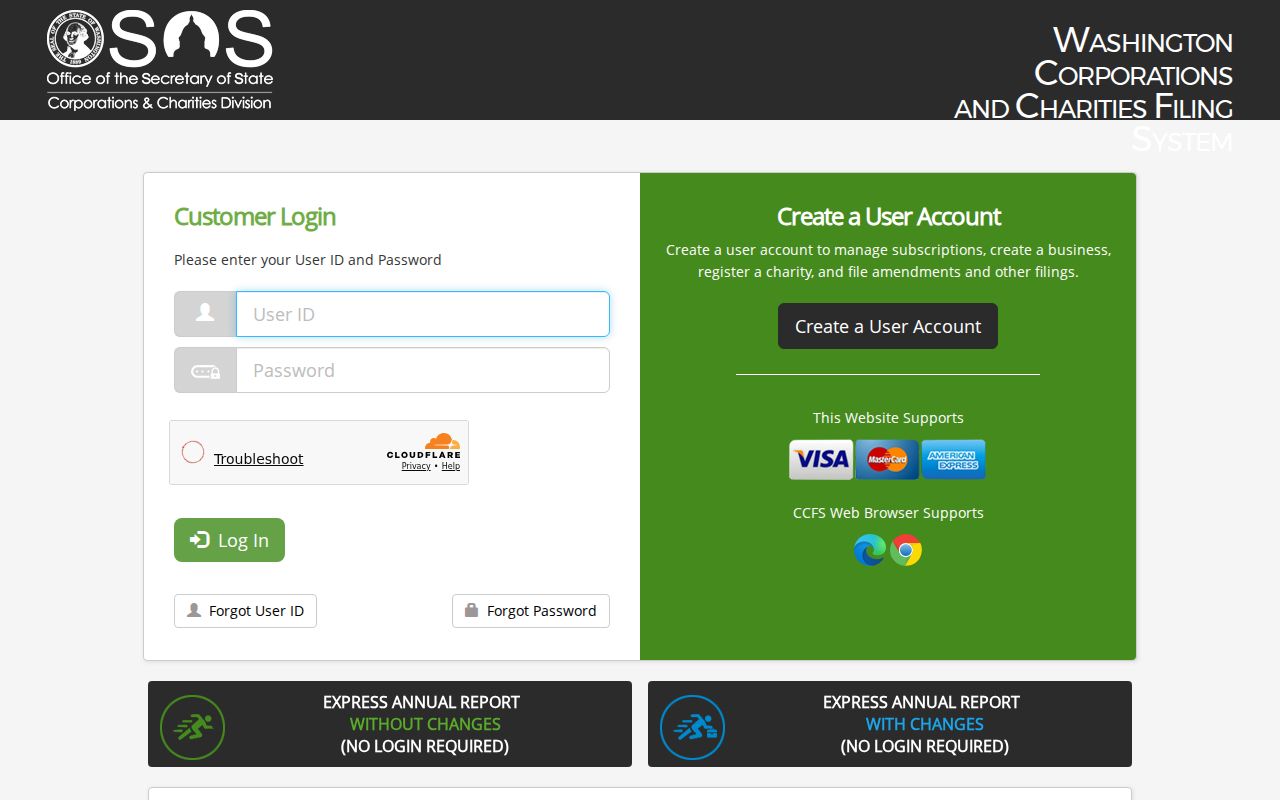
Use filing details to identify the legal entity and its custodian records. A registered agent may receive business mail without being an owner or resident.
A CCFS business detail can include fields such as:
- Business name, UBI, entity type, and status
- Principal office street and mailing addresses
- Formation or registration, expiration, jurisdiction, duration, and inactive dates
- Nature of business and registered agent
- Filing history, file-stamped records, notifications, certificates, and CSV search-result exports
| Official public record | Paid profile category | How to verify |
|---|---|---|
| Names, dates, and fields kept by a named government custodian | Combined summaries from several data sources | Return to the agency or county that holds the original record. |
| Defined search scope and stated access limits | Coverage and update timing may be unclear | Compare the record date, county, and address type. |
Request Washington Public Records
When an online search is incomplete, contact the office that holds the record. The Washington Public Records Act, chapter 42.56 RCW, covers identifiable existing records. Under WAC 44-14-04003, an agency generally makes an initial response within five business days: it may provide the record, acknowledge the request and estimate timing, ask for clarification, or deny with a cited exemption. It does not have to create a new list or answer a research question by compiling records.
Be precise about the office, person or parcel, record type, and date range. Ask the agency for its copy format and fee schedule. The Secretary of State’s request guidance explains the information that helps staff identify a record; city, county, court, and health offices each have their own request contact and channels.
The Secretary of State public-records guidance gives a state-level example of request instructions and contact routing.
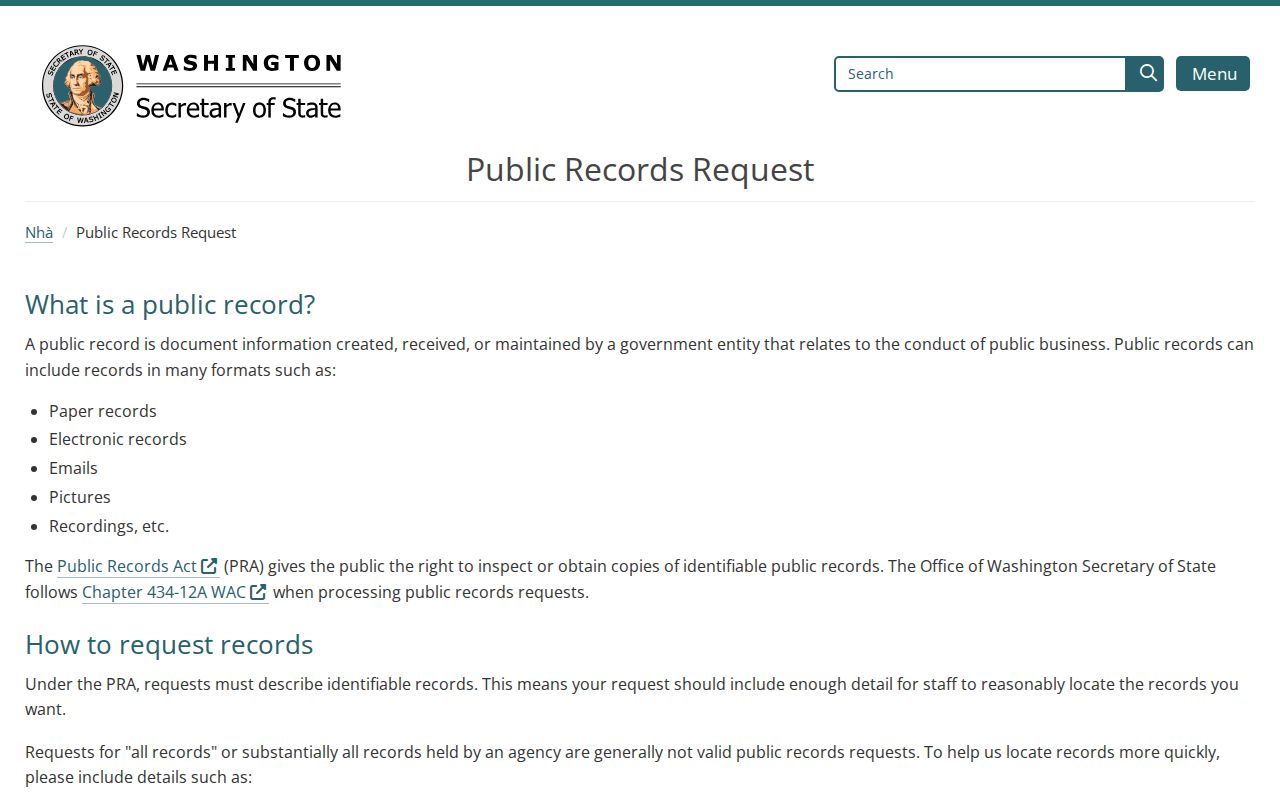
A focused request can name a document number or existing file. It cannot compel disclosure of an exempt record or turn one agency into a statewide resident-list service.
Match Washington ZIPs to Counties
A ZIP Code is a mail-delivery label, not a city, county, or resident boundary. Washington addresses may use a nearby postal city while sitting outside that city’s limits. Some rural, tribal-area, institutional, or PO-box codes do not correspond to a neat map shape. Confirm a delivery address with USPS, then use the parcel and jurisdiction to choose the local record keeper.
The Department of Revenue publishes quarterly 5-digit and ZIP+4 files for Washington. The Office of Financial Management's county population estimates add broad growth context, but do not count ZIP delivery areas. Keep Census ZCTAs separate from USPS routes, preserve leading zeroes in the state download, and label the postal code, county parcel, city, and population measure separately.
Washington Voter File Limits
Washington does not register voters by party, so the public voter roll has no party-preference field. VoteWA asks the registered voter for an exact first name, last name, and date of birth to open that person’s own account. It is not an open search of other people’s registrations. Separate state or county list requests follow statute and expose only permitted fields.
Public lists may include name, address, year of birth, voting history, and precinct or district information. Full birth dates, identification numbers, signatures, and protected-voter information are not ordinary public fields. Commercial solicitation from voter lists is prohibited under Washington law. Check the Secretary of State or county elections office for current request terms rather than treating a list as a neighborhood directory.
Lawful use. Public records support personal, lawful research. Do not use a Washington record to stalk, harass, intimidate, or harm another person.
Why Washington Records Go Missing
A missing name can reflect a date gap, a county-specific portal, a spelling change, a restricted file, or a record that stayed on paper. It does not prove that a person never lived in Washington. Try the county tied to the address, alternate name forms, the proper archive branch, and the office’s phone, mail, or counter channel.
The state Address Confidentiality Program gives eligible participants a substitute address for new government records and keeps their names and addresses out of public voter lists. It does not erase every older record. Use the official ACP information for safety and eligibility details; never treat a protected result as an invitation to seek a hidden address.
Washington’s boundaries have shifted too. Counties formed at different times, local governments annexed land, and postal labels do not always match present city limits. Historical court, deed, directory, and newspaper entries may therefore use a place name that no longer appears on a modern address. Search the historical jurisdiction and the current one.
Washington Archive Digitization Changes
Online coverage can grow, but each record series has its own pace. In 2025 the Washington State Archives announced $506,000 in grants to 27 local-government agencies for imaging, technology, and records management. The new work may improve access over time; it does not mean every county record is already online.
Washington’s record trails remain a mix of current portals, paper files, library shelves, microfilm, and archive catalogs. Keep the date and custodian with each result, then ask what channel holds the next piece. That small habit prevents a recent online index from standing in for a complete history.