
Washington Previous Residents by Era
Past residents of a Washington address leave different traces in different decades. County deed and assessor records can tie a parcel to owners, but not necessarily to everyone who lived there. Libraries and archives offer address directories, federal census pages describe households at census time, and building permits can help date changes to a property. Earlier occupants rarely appear in one file, and the owner is not always the person who lived there. The table separates the records by date and purpose so that an owner clue is not mistaken for a household list.
| Source | Years Located | Where Held | What It Can Show |
|---|---|---|---|
| King County recorder | Most online from 1991-08-01; parcel search from 1997-current | Landmark; earlier microfilm at King County Archives | Recorded parties, instrument dates, legal description, images |
| King County property sales history | Generally mid-1980s-current | Assessor property report | Sale dates and consideration where available |
| Washington State Library directories | General collection 1890-present; local runs have gaps | State Library and local libraries | Adult resident, business, and address clues |
| Library of Congress and federal directories | Primarily 1861-1960 | LOC guide, microfilm, selected digital material | Annual or near-annual address and resident evidence |
| Federal census | 1790-1950 under the 72-year rule | National Archives, Census, and libraries | Household, age, relationship, birthplace, and enumeration geography |
| Seattle permits | About 1894-1970 scanned; 1970-2004 microfiche; 2005-current portal | Seattle SDCI | Project, inspection, work date, and applicant or owner lead |
| Seattle Sanborn maps | Examples from 1884, 1888, 1893, 1905, 1949-50 | Library of Congress and local collections | Street, lot, building footprint, stories, and use |
| Newspapers and obituaries | Territorial through modern, depending on title | Washington Digital Newspapers, Chronicling America, local libraries | Death, family, address, and civic clues; verify with the original source |
Start with a deed when the question is ownership, a directory or census when it is a household, a permit or map when it is the building, and an obituary or probate file when it is the end of a life or estate. These are not continuous series. A year missing from one source does not prove the address was empty.
Washington Previous Residents Through a Deed Chain
A deed chain tracks recorded transfers for one parcel. For a Washington address, begin with the current legal description and the most recent purchase record, then follow the previous buyer back to their own acquisition. A street number can change while the land remains the same, so compare every description against the parcel rather than trusting the address alone. A deed proves a recorded conveyance; the assessor's sales-history line is only a finding aid.
- Write down the parcel number, legal description, current taxpayer or owner, and any available sales-history date from the county property record.
- Find the latest deed in the county auditor or recorder index. Record the grantor, grantee, date, instrument number, consideration if shown, and legal description.
- Search the same parcel or legal description and look for the prior grantor as the earlier grantee. Name searches may need a comma-formatted name and a narrow date range.
- Repeat the search backward, checking each instrument for the same land. A subdivision, merger, partial conveyance, or boundary change can break a simple parcel search.
- When the online series ends, use the county's older name index, deed books, microfilm, archive staff, or the records request route for that county.
- Grantor / grantee
- The grantor conveys an interest; the grantee receives it. One person's role changes from deed to deed.
- Chain of title
- The ordered set of recorded transfers that connects earlier owners to a later owner.
- Legal description
- A land description using a plat, lot and block, section, condominium, or metes-and-bounds call. It often survives a street-name change better than a house number.
In King County, most recorded documents are online from August 1, 1991; older documents are on microfilm at King County Archives. The recorder accepts online, phone, mail, and in-person copy requests. Uncertified copies can print immediately online; certified copies are mailed within five business days. The recorder's mail form asks for the requester, document details, parties, date or range, parcel or plat details, copy type, and payment.
The King County recorder's official records page describes the online search and its copy routes.
The index has changed over time, so a result gap may be a date or name-index problem. Use the instrument image for the legal chain, and ask the recorder about current copy fees before ordering. The Washington Attorney General's local-record copy alert explains why a third-party seller may charge for records available from the custodian.
Washington Previous Residents and King County's Cutoff
King County is the researched Washington example, not a statewide rule. Its recorder says most recorded documents are online starting August 1, 1991. A parcel-number search reaches 1997 to the present, so an earlier transfer may require a name and legal-description search even when the parcel is known. King County property detail describes online sales history as generally beginning in the mid-1980s, which is a separate finding aid and does not replace the deed image.
The other 38 counties run their own auditor or recorder systems and may have different index starts, search fields, fees, counter hours, and archive routes. Do not carry King County's dates into a Washington address elsewhere. Check the local recorder's official page or ask the records desk where the pre-digital index and deed books are held. When the address county is uncertain, first establish the county from the parcel or historical boundary evidence. That county-first step matters because index and archive routes differ across Washington.
This comparison matters because the same address can have a decades-long property tax trail and a shorter online deed trail. The gap is a digitization limit, not proof that no earlier owner existed.
Washington Previous Residents: Recording Alerts and Old Deeds
A recording alert can help a parcel owner notice a later filing, but it cannot reconstruct prior residents or establish title. King County's Recording Activity Notification System accepts a confirmed personal or business name, an email address, and an optional first ten parcel digits. It is a notification service, not title evidence and not a guarantee that every filing will generate a notice.
The King County RANS page explains registration and the service's limits.
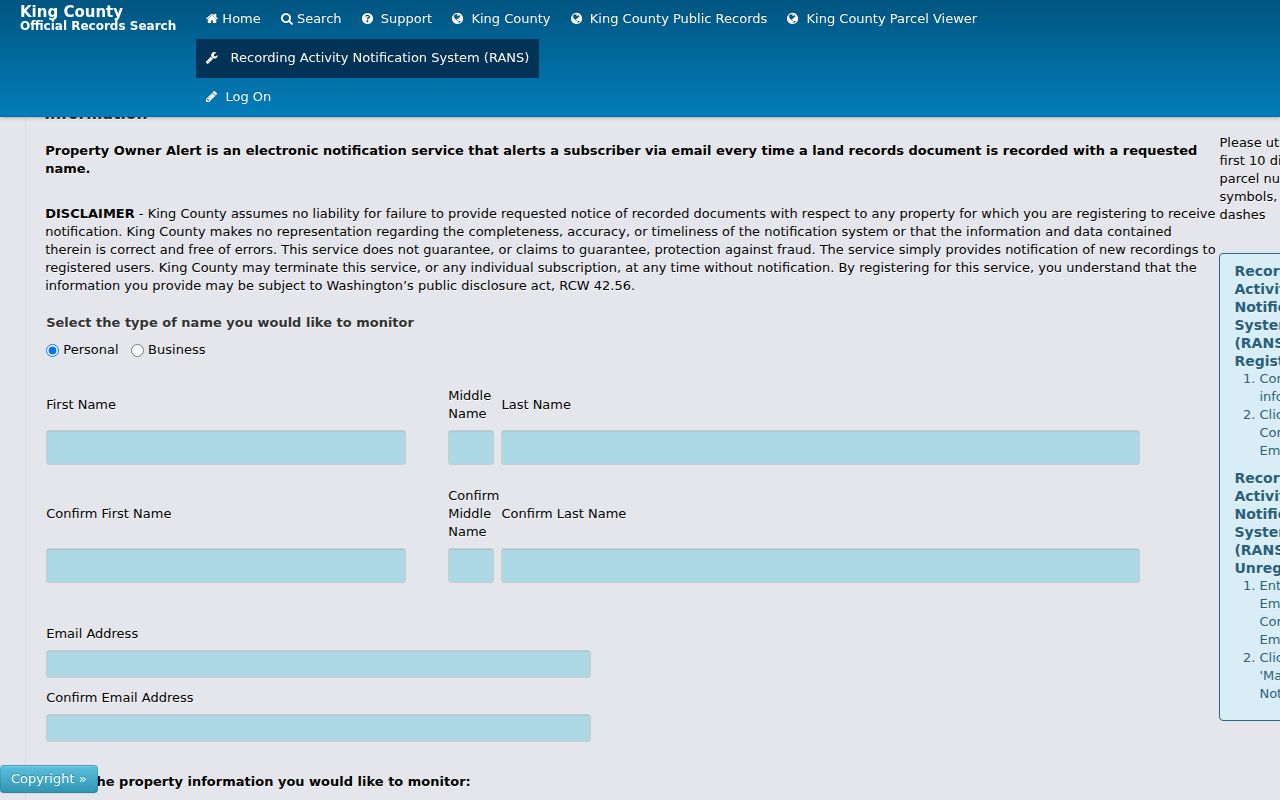
For a backward history, use the recorded instrument and earlier index, not the alert. Keep the parcel number, legal description, search date, and any alert notice separate in your notes so a future filing is not confused with an old transfer.
Washington Previous Residents in Directories and Census Years
Directories help fill the years between federal censuses, but the two sources do not describe the same moment. Washington's State Library says its city and county directories generally span 1890 to the present across 35 counties and 300 cities, with gaps in individual runs. Its index is a catalog, not proof that every year is on a shelf. The Library of Congress directory guide describes formats and coverage primarily from 1861 to 1960. Local librarians can check the exact city, year, and street section.
- Write the target address, the county, the likely decade, and any known surname spelling or initials.
- Check the alphabetical directory section for a name, street number, spouse or widow notation, and any address or household marker defined by that volume.
- Search the same year's street or reverse section. It may connect the address to an adult resident or business when the name changed or appeared in abbreviated form.
- Compare nearby directory years, then use a federal census page for the closest available census date. Public census schedules are released through 1950 under the 72-year rule.
- Carry the address into deeds, maps, permits, obituaries, probate, or cemetery records, and label which source supports each claim.
A directory can reflect a different canvass date, omit some household members, or include a boarder or business. The 1950 census opened in 2022. Washington archives also began a partnership to microfilm archival newspapers and manuscripts in 1951, a reminder that older evidence may be on film even when no searchable web index appears.
Seattle House History for Washington Previous Residents
Seattle has a local address-history route that joins permits, tax records, directories, and maps. The Seattle Permit and Site History Research Tool accepts an address or map selection and links to site characteristics, permit tracking, historical documents, and active projects.
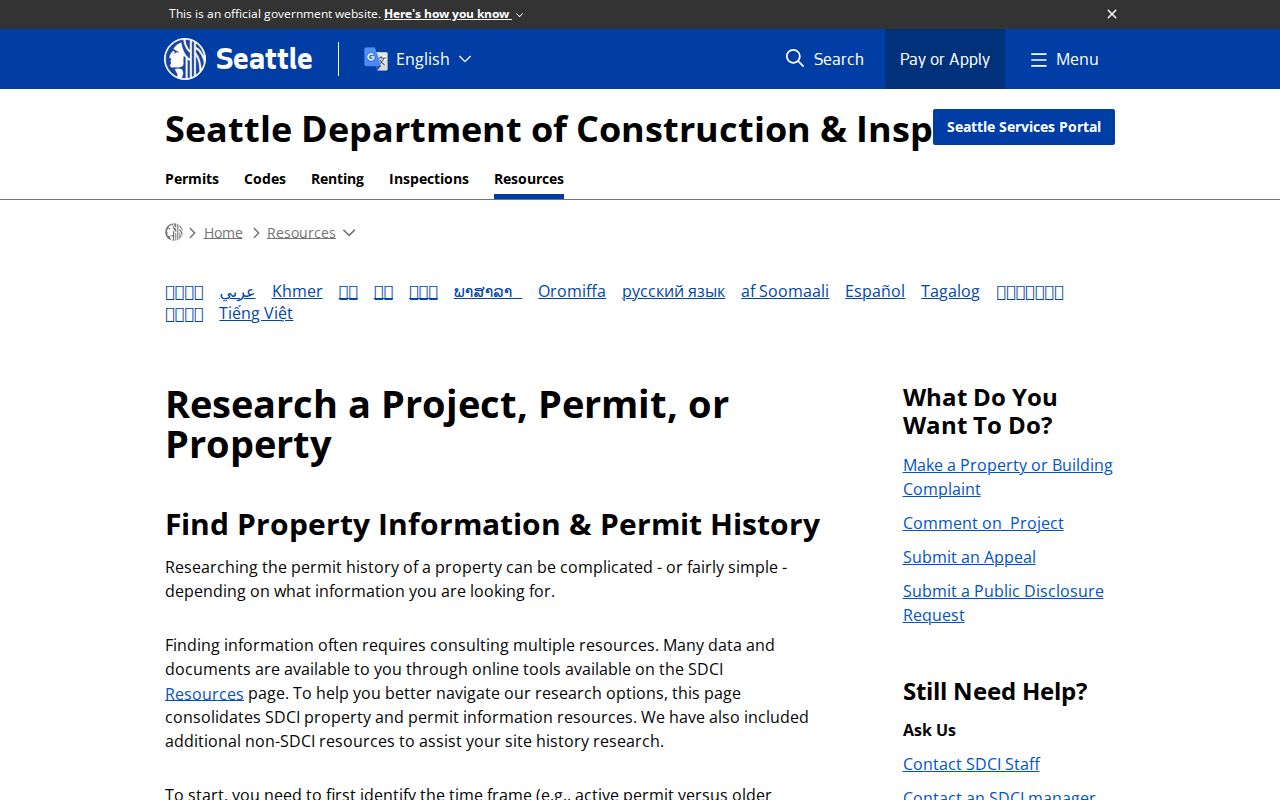
Seattle's current portal covers permit activity and project documents from 2005 onward. Scanned historical permits reach about 1894 to 1970, with 1970 to 2004 material on microfiche and some roll-film exceptions. Approved plans for many recent permits require a separate written request, and some facilities are restricted. A permit can date work or name an applicant, but it does not prove who lived at the site.
The Seattle City Archives property-history resources point to King County recordings before 1991, Sanborn maps, and city directories held at the Municipal Archives, Seattle Public Library, and University of Washington. The guide also describes 1930s and 1940s county property-tax cards and photographs, a reverse property lookup that began in 1938, and a longer building-history research guide. These are Seattle-specific holdings, not a statewide promise.
The Seattle City Archives property-history page ties local permits, maps, tax cards, and directory locations together for a Seattle address.
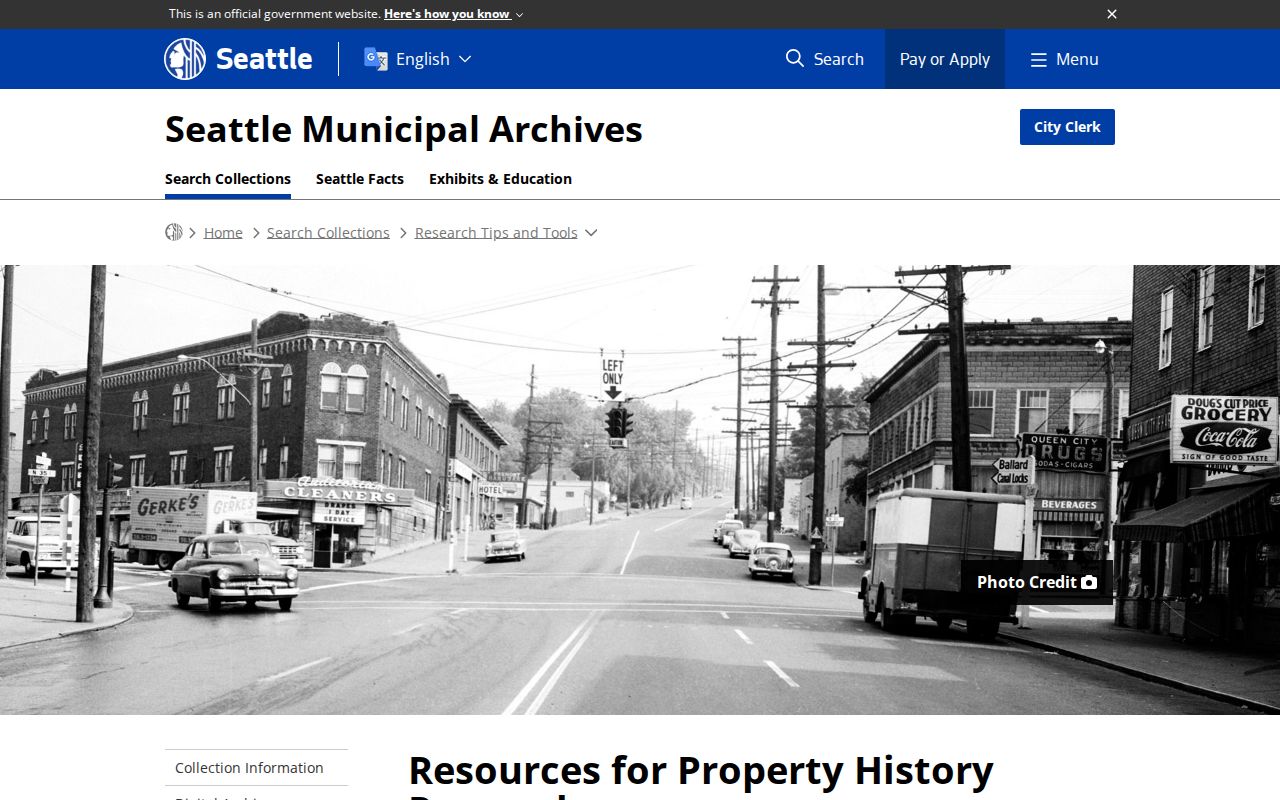
The guide is a local research model. Other Washington cities may keep their older records in a city clerk's office, county archive, regional branch, or library.
Sanborn Maps for Washington House History
Sanborn fire-insurance maps can test whether a building and street layout fit a proposed address history. The Library of Congress Seattle collection includes examples from 1884, 1888, 1893, 1905, and 1949 to 1950. A sheet may show lot outlines, building footprints, construction material, stories, outbuildings, street names, and occupancy or use labels. It does not name every resident and cannot replace a deed.
The digitized Library of Congress Seattle Sanborn set is one starting point; coverage for other Washington towns varies by city and collection. Match the map's sheet, year, block, and orientation with a plat or directory before treating it as the same property. A building footprint can support a house-history timeline without proving who occupied it.
Washington Street Names and Parcel History
A house number may not have stayed fixed across the full Washington record trail. Cities have changed street names, numbering patterns, limits, and postal labels; annexation, subdivision, road vacation, and new units can add more breaks. No single statewide readdressing register was located. Before deciding that an older record does not match, compare the current parcel and legal description with old plats, Sanborn sheets, directory street indexes, city engineering records, and newspaper notices.
Washington's territorial government began in 1853 and statehood followed in 1889. County formation and boundary dates also differ, so an older deed or directory may use a county or place name that no longer matches today's address. Assign the old place to the county that held it at the time, then use that county's archive or the regional State Archives branch. Postal city and ZIP are delivery labels, not title identifiers.
Compare Washington Permit and Deed Eras
A permit timeline and a deed chain are complementary, not interchangeable. A deed tells who conveyed an interest in a parcel and when the document was recorded. A permit can show work, inspection, project applicant, or owner and agent as listed by the issuing department. A map may date the building's shape, while a directory suggests who was associated with the street number in a particular year. The source that reaches furthest back may still answer a narrower question.
For a Washington house, place each item on a timeline with its custodian and record date. A scanned permit from an earlier decade does not fill a deed-index gap, and an owner named on a deed is not automatically the person named in a household directory. Comparing the sources can reveal a useful lead, but each claim should stay tied to the record that supports it.
Washington Records Archives for House History
Washington has no single statewide house-history service. The State Library, local public libraries, county historical societies, county archives, and State Archives branches each hold different pieces. Ask for an address file, house-history guide, reverse directory, newspaper index, tax card, old plat, permit microfilm, obituary, or cemetery reference rather than requesting a broad search for every record about a person. Give the exact address, an older street name if known, the county, and a useful time span.
The State Archives Digital Archives indexes selected state and local series and may provide images or transcripts. Paper records and non-digitized collections may require a phone inquiry, appointment, in-person visit, mail request, or public-records request to the office that holds them. The State Library's ordinary public access in Tumwater ended in 2025; its current directory page describes limited Thursday appointments, while local library access varies.
For a new Washington research pass, keep the county first, then add a city, archive, or library only when the record belongs there. A negative online result is a prompt to ask about shelf, film, or transferred series, not a complete finding about the people who once lived at an address.
Washington Previous Residents in Household Records
Property files show ownership; older directory and census entries can put people at an address during a given period. Washington's city and county directories often list adults, businesses, occupations, and street numbers, while a census records the household on its enumeration date. Neither should be read as a live roster or as proof of continuous residence. The collection details belong on the Washington city directory page; here they serve as dated steps in an address history.
When the trail reaches an earlier household, newspapers and obituaries may name relatives, a former street, or a funeral home. Probate can identify an executor, heirs, or estate property. Cemetery records add burial and family clues. These sources can help identify past residents after an address has changed hands, but they do not prove a complete household list. Verify each clue with the original county, court, newspaper, library, or archive record, since an obituary is family-supplied and may not state an exact address.
Lawful use. Washington address history is useful for family history, house research, and personal curiosity. Do not use records to follow, threaten, or harass a living person.