
Records in a Washington Resident Lookup
Washington has 39 county systems for property, elections, courts, and local records, alongside statewide indexes and agencies. A useful search assigns the person or event to the right county, then compares records that answer different questions. A county assessor can link an owner or taxpayer to a parcel, but it does not prove who lives there. A court index locates a case, while the filing court holds the full record. Treat every result as a lead to verify with the office that keeps it.
| Record | What it may confirm | Custodian or source | Access |
|---|---|---|---|
| Property roll | Taxpayer, parcel, site and mailing address | County assessor and GIS | Local portal, counter, or request |
| Recorder index | Recorded parties, deed, lien, or plat | County auditor/recorder | Online range varies; older books may be in archives |
| Court index | Party, court, case number, type, and filing year | Washington Courts and filing court | Index online; complete file from clerk |
| Vital record | Birth, death, marriage, or divorce event | DOH, local custodian, or archives | Product and eligibility rules differ |
| Voter record | Registrant's own status; limited public-list fields | VoteWA, county elections, or State VRDB | Sign-in or lawful list request |
| Historic directory or news | Dated residence, occupation, household, or obituary clue | Libraries, archives, and newspapers | Collection-specific; years may be missing |
Start with the record that fits the fact being checked. A known parcel points to the county assessor and recorder. A court-related name belongs in a court index and then with the clerk. A birth, death, marriage, or divorce question belongs with the state vital-record system or historical custodian. The county depends on the address, filing, or event, so begin with the State Treasurer's county assessor and treasurer list and select the office tied to that location.
Washington Courts Search Fields and Limits
Washington Courts Search offers case, person, attorney, and hearing-date routes across municipal, district, superior, and appellate indexes. The interface asks for court level, search type, court, case type, and filing year in the applicable modes, then uses a name, case number, or business name. Person Search takes first and last name, with middle name optional. Names are not case-sensitive; an Odyssey quick guide describes asterisk wildcards for incomplete names or numbers, subject to its minimum characters.
| Field or choice | Type | Required | Format or use |
|---|---|---|---|
| Court Level | Tab or dropdown | Case Search | Municipal/District, Superior, or Appellate |
| Search Type | Dropdown | Yes | Name, case number, or business name |
| Court Name and Case Type | Dropdowns | Local court search | Court-specific choices; categories vary |
| Year Filed In/After | Year field | Local court search | Narrows the filing period |
| First, Middle, Last Name | Text | First and last required for person search | Middle name optional in the Person Search route |
| Case Number or Business Name | Text | When that mode is selected | Case-number partial or wildcard support depends on portal |
| Attorney Bar Number | Text | Yes in Attorney Search | District or municipal attorney search |
| CAPTCHA and disclaimer controls | Challenge and buttons | Before search | Accept and Continue, Search, Clear, and hearing-date Verify flow |
Statewide results update about every 24 hours and are reference information, not the official court record. The portal warns that completeness, identity, and current status are not guaranteed; dockets, judgments, and document links may be missing. Seattle and Spokane have separate current court portals, King and Pierce use separate superior-court systems, and Odyssey serves many other superior courts. Pick the exact court from the Washington Court Directory when a statewide search is thin.
A result can show a party name and role, case number, court and level, case type, filing year or date, and sometimes a docket link. Status or disposition may be absent or wrong, and document copies come from the court. A quick guide describes asterisk wildcards for incomplete names or numbers, with minimums of one first-name character, three last-name characters, and four case-number characters.
What a Washington court result may show:
- Party name and role, such as plaintiff, defendant, petitioner, or respondent.
- Case number, court name, and court level.
- Case type or category and filing year or date, where returned.
- A docket link in some superior-court results; status or disposition may be incomplete.
- Document links when supplied; copies must be ordered from the filing court.
- No ordinary public detail for sealed, expunged or vacated, juvenile, adoption, or protected family material.
The statewide name index is a lead, not proof that a matching person is the same person in your records. For actual pleadings, judgments, and copies, the Washington Courts self-help guide explains how to find the court that holds the case file.
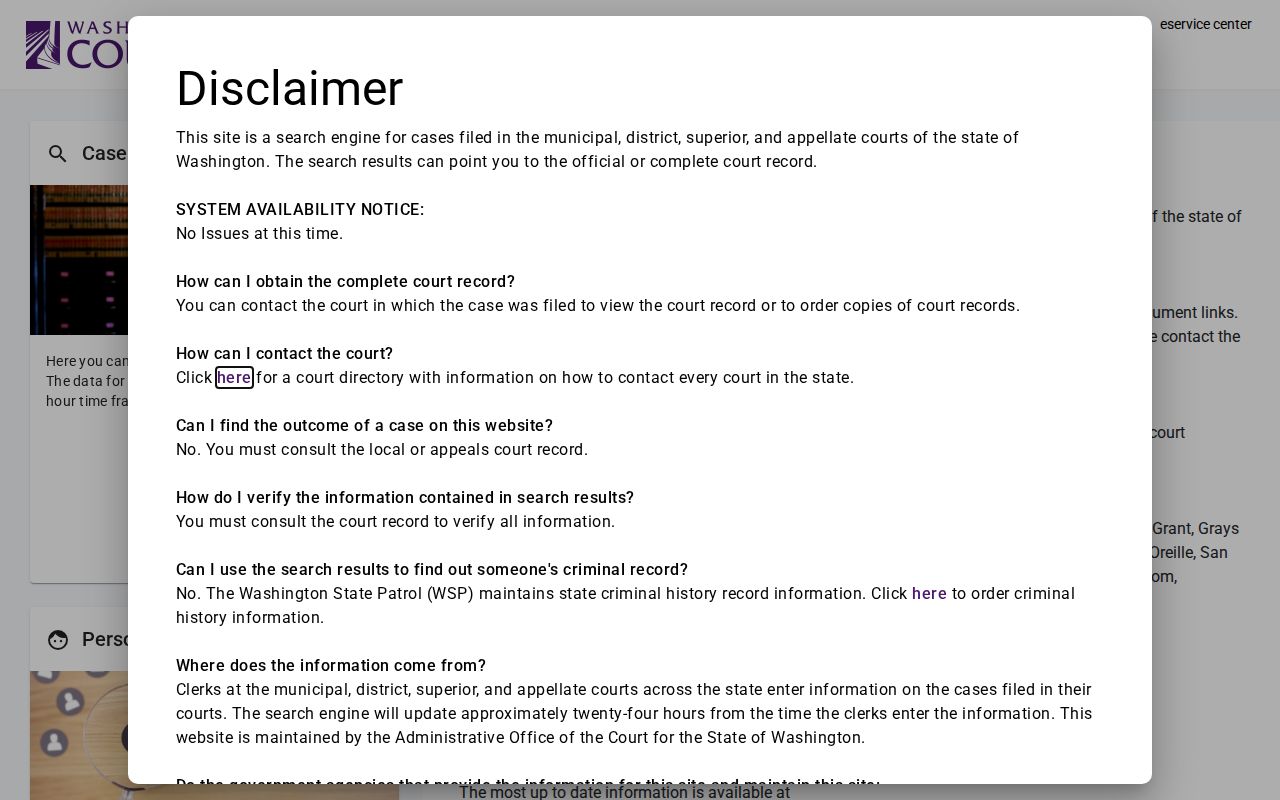
Use the court name and case number from the index when you contact the clerk for a docket or document copy.
Verify a Washington Resident Across Records
A name match needs a second or third point of agreement. Keep the county, approximate age or year, address type, record date, and source beside each result. A shared name with the wrong county or a conflicting age is a reason to pause, not to merge files. Use only the details needed to distinguish the records, and ask the custodian for the official copy when the distinction matters.
- Write the full name and known variants, likely county or city, approximate age or year, and last known address.
- Search the relevant county assessor or GIS by address or owner name, then note whether an address is the parcel site or a mailing address.
- Run a Washington Courts person search with the name forms and likely court; retain the case number and filing year for the local clerk.
- Compare independent dates, county, address, and family links. Use a vital record or dated directory only when it fits the question and the access rules.
- Ask the record custodian to confirm the filed record and copy process; do not treat an index alone as final proof.
- Docket
- A case's list of filings and events maintained by the court.
- Index vs image
- An index points to a record; an image is a scan of the document and may not be available online.
- Certified copy
- A copy issued by its custodian with an official certification; a portal printout is not automatically certified.
Property reports also need careful reading. The situs or site address identifies the parcel's physical location, while the mailing address is where tax notices go. The listed taxpayer may be an owner or entity, not the person who occupies the parcel. If the search shifts from one named person to every record tied to a street, use the Washington street directory process and keep each owner or address entry tied to its own source.
VoteWA Is Not a Washington Name Search
VoteWA is a sign-in service for the registered voter to review their own record. It requires the first and last name plus date of birth to match the registration. After sign-in, the voter may see status, residential and mailing addresses, county, ballot status and materials, voting history, elected officials, and voting or drop-box information. It is not an open tool for entering another person's name and browsing a public address list.
| Portal field | Type | Required | What it means |
|---|---|---|---|
| First Name | Text | Yes | Must match the registration record |
| Last Name | Text | Yes | Must match the registration record |
| Date of Birth | Date text | Yes | Enter MM/DD/YYYY as held on file |
| Sign In | Button | After fields | Opens the registrant's own portal |
| VRDB request: name, email, phone | Requester fields | Yes | Identifies the person requesting a download |
| VRDB request: address, city, state, ZIP | Requester fields | Yes | Contact and mailing details for the request |
| Information requested and county | Choice fields | Yes or conditional | Select one file and county scope as offered |
The Secretary of State's Voter Registration Database extract request is a separate route. It contains active registrations, the current and prior year's voting history, and district or precinct information. It is a delimited CSV, refreshed monthly, and requests may take up to five business days. In September 2025, the Secretary of State said public fields include name, address, year of birth, and voting history; full birth date, driver's-license number, and SSN fragments remain protected. Washington voter files also have no party-preference field. The Secretary's statement describes that public and protected field split.
Current lists and poll books are subject to RCW 29A.08.710 and .720. The law bars using them to send commercial solicitations, while political uses are allowed under the stated rules. County elections offices can explain the current list request, public counter, and historical register process. Vote history says whether someone participated in an election, not how they voted.
Washington's voter registration and public-list rules are set out in chapter 29A.08 RCW.
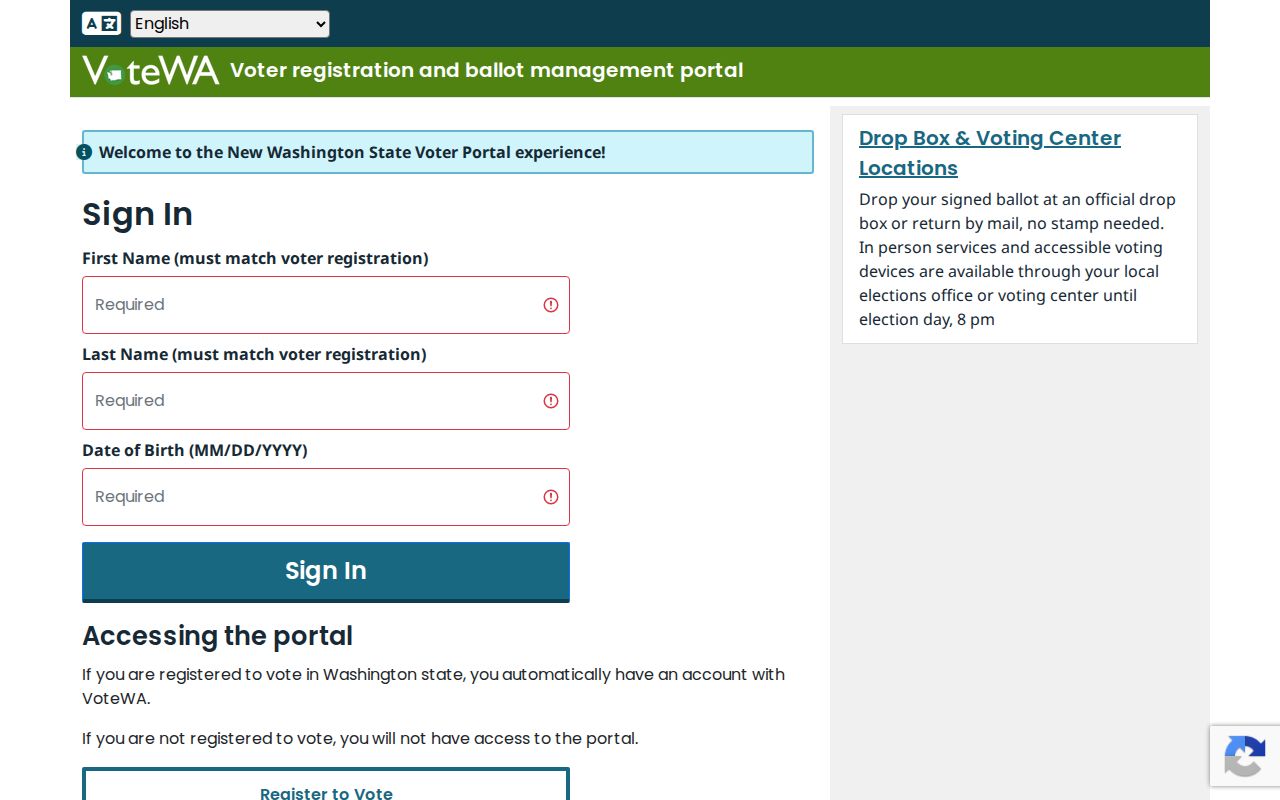
The sign-in screen reinforces that the voter checks their own record rather than using an open name search for other people.
Washington Vital Records for Family Events
The Department of Health Center for Health Statistics issues statewide birth, death, fetal-death, marriage, and divorce products, with some services also available through local health jurisdictions. Its vital-record rulemaking page tracks current public notices and rule changes. A certified birth record requires identity documents, an application, a fee, and a qualifying relationship, such as the subject, specified family, legal or authorized representative, agency, or court under RCW 70.58A.530. Anyone can order a noncertified informational birth copy for personal or genealogical use, but it is not legal proof.
Washington birth records held by DOH begin July 1, 1907. The birth application asks for the subject's name, birth date and place, and parents' names, along with product, requester, delivery, and payment details. The base fee is $25, and online or phone vendors or local services can add charges. DOH does not offer a free phone search to verify whether a birth record exists; a complete application and payment are required.
Historical vital records move to State Archives after 100 years for births and fetal deaths, and after 25 years for deaths, marriages, and divorces. DOH handles marriage and divorce certificates from 1968 to the present. A marriage or divorce request needs one party's name, an approximate event date, filing city or county, application, and fee. A divorce certificate is not the court decree; ask the superior-court clerk for the case file, subject to limits on restricted information.
Order through the current DOH online or phone instructions, by mail, through a local health jurisdiction where offered, or at the state office by appointment for the listed services. Phone and email support can explain the form, but they do not replace it. For an older event, search the Digital Archives, county auditor or clerk, newspapers, church registers, cemetery files, and library holdings. A public-record request does not override vital-record confidentiality.
Review the Washington birth-record product and eligibility instructions.
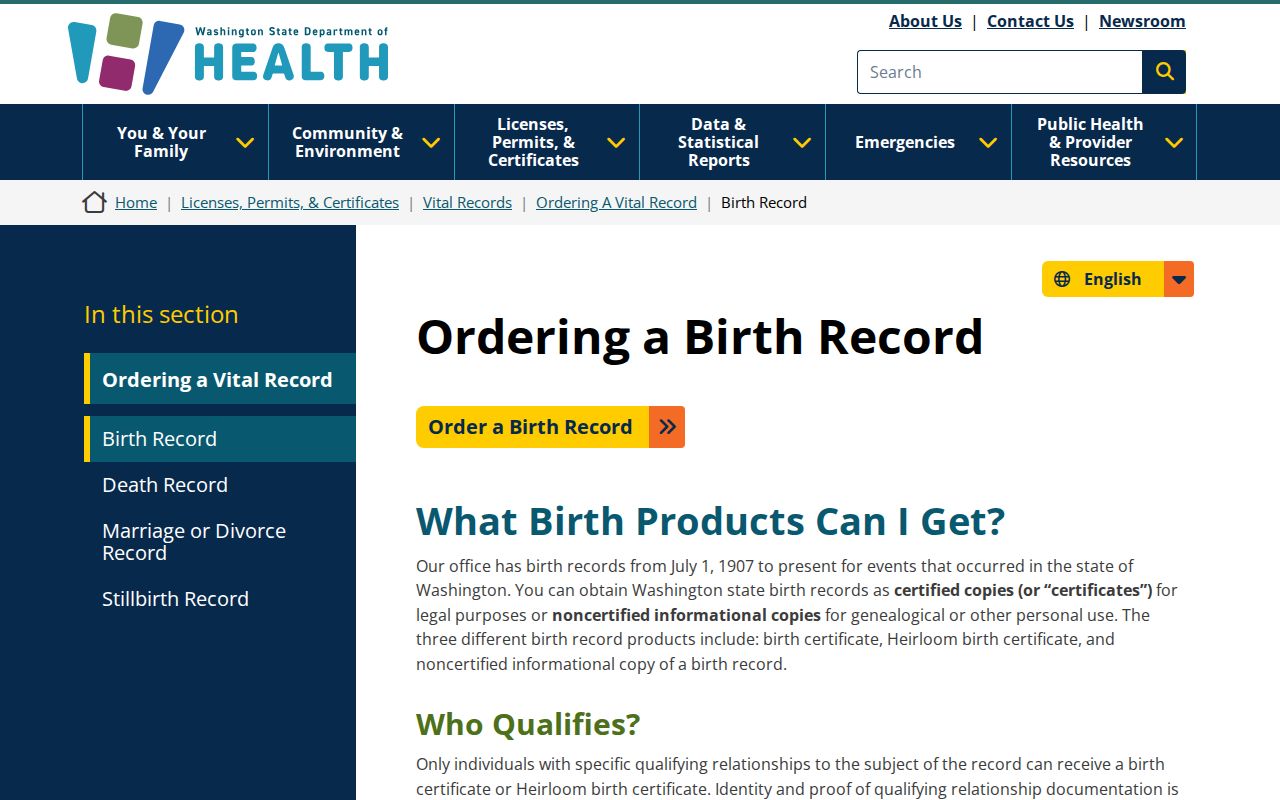
Choose the informational or certified product based on the family-history need and the applicant's eligibility.
Find a Washington Heir, Parent, or Classmate
Different personal searches call for different records. For an heir, start with a superior-court probate or estate index, then ask the clerk for the public file and compare any distribution with recorded deeds. The clerk can identify the case and copying steps, but cannot decide whether two people with a shared name are the same heir. Probate papers, newspaper notices, cemetery material, and family records may each supply a separate link.
For a birth-parent search, Washington directs people to official adoption-information channels, including DOH adoption information and confidential-intermediary services. Adoption records are not an ordinary public name lookup. Follow the current official eligibility and process instructions, and do not infer a family relationship from a third-party index alone.
A former classmate may be easier to place through yearbooks, alumni publications, campus newspapers, local newspaper archives, and historical directories. The Washington city directory collections can add a dated address or occupation, while a yearbook may connect a name to a school and year. University and historical-society collections differ; check their finding aids and ask whether a roster is public or requires permission.
For a death or family transition, combine an obituary with the newspaper title, cemetery, probate, and a record from the correct county. An obituary is often supplied by family and may omit an exact address. A directory may list an adult in one year and not the next, but that alone cannot establish death, a move, or a relationship.
Washington Business and License Clues
A business record can help distinguish a name or explain why an address appears in a filing, but a company office or registered-agent address is not proof of a person's home. The Secretary of State's Corporations and Charities Filing System searches public corporation records by business name or UBI. Detail pages can show entity type and status, principal street and mailing addresses, formation or registration dates, jurisdiction, registered agent, and filing history. Public results do not need a login, and records for entities inactive more than ten years move to State Archives.
The Department of Licensing is a starting point for many professional and business credentials. Specific license searches are public, but bulk lists may be limited; fields and access differ by profession. A custom data file is charged at actual cost, listed by DOL as $60 per hour. Confirm the profession-specific agency before relying on a result, and read a license as a credential rather than proof of residence.
County assumed-name filings, city permits, and state business registrations can be held by different offices. Search the county auditor or Secretary of State based on filing type, then ask the relevant records unit for an existing register if there is no public portal. A public index may omit inactive or older business files that remain in an archive.
Washington Public Records Request Fallbacks
When an online index stops short, contact the custodian that would hold the existing record. The Washington Public Records Act, chapter 42.56 RCW, calls for an initial response within five business days. An agency may provide the record, acknowledge the request and give an estimate, ask for clarification, or deny access with a cited exemption. It need not create a new list by joining separate systems.
For court material, use the clerk's public-access computer or call the court identified in the Court Directory. Give the party name, case number, filing year, and document type, then ask about older storage, copy, retrieval, and certification procedures. County elections offices offer their own counter, phone, and list-request routes; county auditors and recorders can explain older deed books, microfilm, or archive transfers. Local health departments, libraries, and regional archive staff provide separate channels for vital and historical records.
A narrow request is easier to route than a demand for every record about a person. Name a record type, date range, known case or parcel number, and agency. The five-day rule is an initial response deadline, not a promise that all records are ready within five days. Existing records may still be withheld or redacted under the law that applies to them.
Protected People in a Washington Resident Lookup
Washington's Address Confidentiality Program (ACP), governed by chapter 40.24 RCW, provides an official substitute address for eligible survivors of domestic violence, sexual assault, stalking, or trafficking, threatened criminal-justice or election officials, and protected health-care workers. An Application Assistant supports the safety plan and threat assessment, and certification lasts four years. State and local agencies, courts, and law enforcement accept the substitute address for new records, subject to statutory exceptions. The program forwards first-class mail and can protect voter and marriage-record exposure, but it does not erase older records.
A participant's actual residential, mailing, county, city, and precinct information is confidential. ACP participants are excluded from public voter lists; a missing hit can be a safety safeguard rather than evidence that a person never lived in Washington. Other restricted material can include sealed or juvenile court files, adoption and medical records, protected voter fields, and sensitive numbers in recorded documents. Driver data is also restricted by the federal DPPA and RCW 46.12.380.
There is no single Washington removal form for every private profile. For government records, use the ACP before new records are made, or contact the custodian's correction and redaction process. For a private profile, use that publisher's own privacy channel, submit only the minimum needed to identify the entry, save the response, and check again later. An opt-out request cannot delete a lawful deed, court file, historical directory, or archive record.
Use records lawfully. Washington public records are for personal, lawful research. Do not track, threaten, expose, or harass anyone; repeated monitoring or unwanted contact can cross the state's harassment and stalking laws.
Correct a Washington Record at Its Source
A clerk can often confirm that a record exists in an office index, provide an instrument or case number, explain the date range, or tell you where the full file is kept. A clerk generally cannot prove that two same-name entries are the same individual, infer current residence from an old mailing address, release a protected field, or build a new cross-agency list. Keep a simple source note with the date searched, spelling tested, county, record identifier, address type, and known coverage limit.
Send corrections to the custodian responsible for that field: an assessor for a property roll, elections for registration, DOH for vital-record amendments, the court clerk for case-index errors, or SOS and DOL for their filings and license data. Keep the original result and the office's reply. Do not alter an official copy yourself. If no result appears, report the portal, date range, and name variants searched rather than concluding that the person or event never existed.