
Washington Neighbors Around One Address
A block search in Washington starts with the parcel around the address in hand. County GIS may show adjacent land, street segments, zoning, districts, and taxpayer summaries. An assessor report adds current parcel details. A voter list, permit file, directory, or neighborhood contact page can add a separate kind of clue, but each has its own rules and date range. The first table separates what these sources show from how a researcher can reach them.
| Washington Source | What It Can Show Nearby | Access Route |
|---|---|---|
| County GIS parcel viewer | Nearby parcels, street segment, boundaries, zones, districts, and map context | Online viewer; select, buffer, or export where offered |
| Assessor reports | Taxpayer or owner, site and mailing addresses, value, legal and building fields | County property portal, counter, or request |
| County recorder | Recorded ownership sequence, plats, easements, liens, and parties | Index, copy request, counter, phone, mail, or archive |
| Voter file or list | Public fields for registered voters at a lawful geography | County or Secretary of State request; restrictions apply |
| City or county permits | Work, applicant or agent, inspection, violation, and date | Local portal, department, or public-records request |
| Reverse directory | Historical address-to-adult-resident or business clue | Library, archive, catalog, or digitized volume |
| Neighborhood association | Boundary, public contact, meeting details, or civic organization | City or county directory; rosters are generally private |
| Local history collections | Newspapers, obituaries, maps, yearbooks, and older block context | Library or historical society reference staff |
- Parcel
- A county-assigned piece of land used to connect a mapped lot with property and tax records.
- Buffer
- A map distance around a selected point, line, or area that can help select nearby parcels.
An owner or taxpayer is not a verified household member. A voter list includes only registered voters in its public field set; a neighborhood page identifies a civic contact or boundary, not its members. Use a source only for the fact it records and label any inference about nearby households.
Map Washington Neighbors Around a Parcel
King County's Parcel Viewer shows the block method in a working Washington map. Find the target address, select its parcel, turn on parcel and address-point layers, then use a click, line, freehand line, polygon, or freehand polygon to select nearby land. A buffer tool can add an adjacent or radius selection in feet. Choose only the nearby lots needed to answer the question, and keep the map date with the result.
The King County Parcel Viewer also offers measure, zoning, cross-street, export, and clear controls. Its parcel lines are approximate and the map is not for legal use.
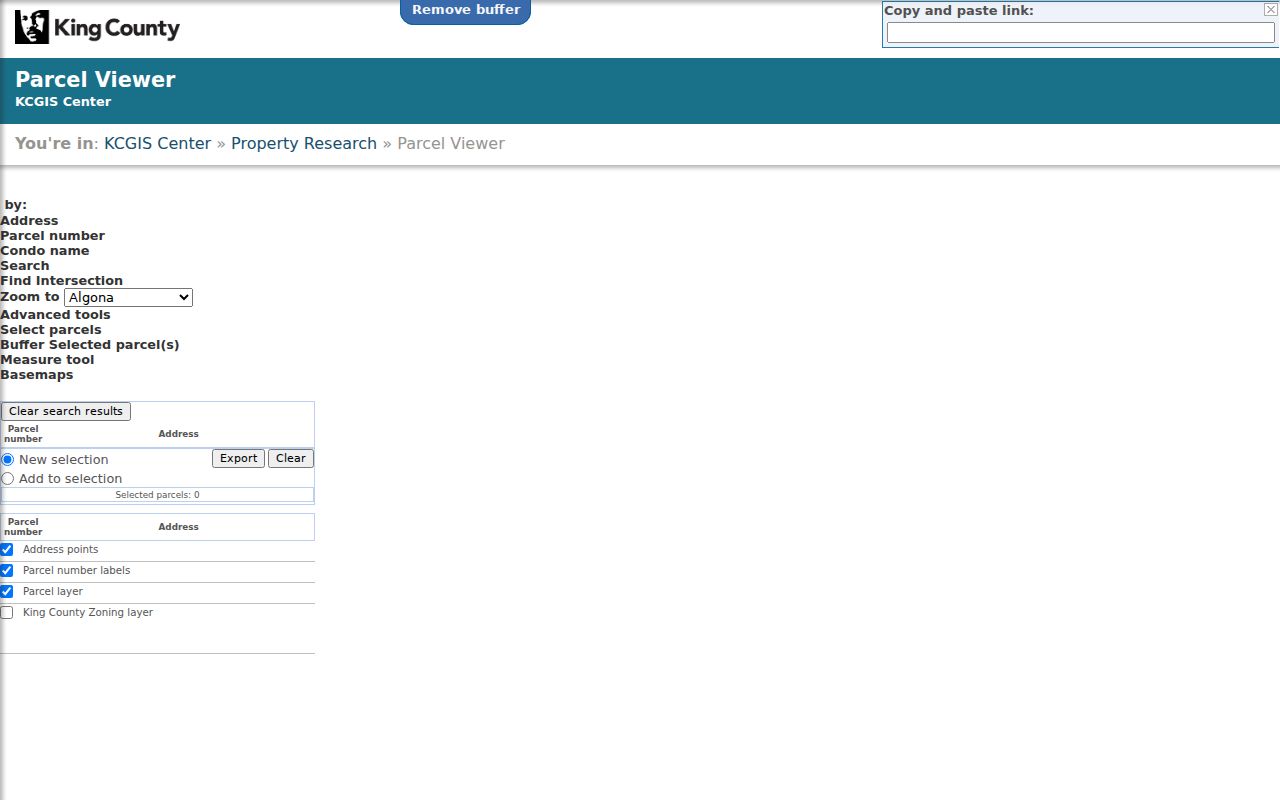
The selected parcel summary may show taxpayer name, address, jurisdiction, appraised value, lot area, levy code, and unit or building count, with links to property and district reports. This is a current parcel finding only. For a full street-by-street record chain, follow the Washington street directory workflow.
- Search the address or cross-street and note the county map layer and date.
- Select the target parcel, then add only the adjacent parcels or street segment that fits the block question.
- Open the summary or property report to record the taxpayer and parcel fields; do not treat them as proof of who lives there.
- Use the county recorder or local permit office only when a recorded transfer or project date is needed.
Washington Neighbors and Voter Records
Washington's VoteWA portal lets a voter check their own registration; it is not an open search for all people at a street address. Current voter lists and poll books are available through a county elections office or the Secretary of State under chapter 29A.08 RCW. The statewide voter database extract includes active voters, the current and prior year's voting history, and precinct or district information. It is updated monthly, usually by the end of the first business day, and a request may take up to five business days.
At the public level, the file may show name, address, year of birth, voting history, precinct or district, and status. It does not expose full date of birth, driver's-license number, Social Security fragments, signature image, registration source, or protected voter details. Washington has no party-preference field. Vote history marks participation, not a person's choice. Lists may be requested at the county counter or from the state, with reproduction cost and statutory limits.
Commercial solicitation from a voter list is prohibited under RCW 29A.08.740 and can be a class C felony. Political use is allowed under the statute. A voter list is not a list of every person who lives on a block: nonregistered people and Address Confidentiality Program participants will not appear in ordinary public results.
Washington Neighbors: Neighborhood Contacts
Washington has no single statewide roster of neighborhood association members. City and county directories are more useful for finding an official boundary, public contact, or open meeting. These resources can help identify a civic group near an address without claiming that its contact list names everyone who lives there.
| Public Resource | How It Helps | Contact Route |
|---|---|---|
| Spokane Neighborhood Councils | Address map assigns a council; pages list council areas and public meeting details. | Use the map, then open the matching council page. Meetings are open to residents and business owners within the boundary. |
| Seattle Department of Neighborhoods | Neighborhood and council-district resources, community connections, and local projects. | Use the city program pages for the relevant neighborhood boundary and public contact route. |
| Clark County Neighborhood Association Directory | Address map, alphabetical association list, boundary, activity status, and coordinator contact. | The county page lists a coordinator phone, 564-397-2316, and explains records referrals. |
The Clark County directory says it does not keep individual HOA records or covenants. It directs a researcher seeking recorded covenants to the recording division and a researcher seeking an association name to the Secretary of State's Corporations and Charities Filing System. A filed organization name does not disclose its members.
Washington Neighbors in Civic Directories
Public civic directories can point to organizations, not private households. Washington 211 and Department of Health community-outreach resources list community-based contacts. University special collections at the University of Washington, Washington State University, Eastern Washington University, Western Washington University, Central Washington University, and other campuses may hold yearbooks, campus papers, oral histories, local photos, and community records. Historical societies may hold obituary indexes, manuscript family papers, maps, and address files.
Congregations, tribal historical offices, immigrant or community newspapers, veteran posts, and service clubs may also preserve records that help describe a neighborhood's past. Access is specific to each institution and may require permission. Ask for a finding aid or an address, surname, or vertical-file check. Do not assume an archive or association keeps a current member roll that can be searched by street.
A useful record request names the organization, item type, and date span. A meeting notice, annual report, newspaper, or historical directory may show a group's public work. It will not establish which people took part unless the source says so.
Washington Permit Records by Address
Permits and code cases can explain changes on a block: a new building, an alteration, an inspection, a street-use project, or a dated complaint. They show the project and people named in that file, such as an applicant or agent, not a complete list of the people who live nearby. Search the city or county that issued the record; Washington has no uniform permit portal for every local government.
Seattle is one detailed local example. Its Permit and Site History Research Tool accepts an address or map selection and links to site characteristics, permit tracking, historic documents, and current projects. Seattle has current portal records from 2005 onward, scanned historical material from about 1894 to 1970, and microfiche for 1970 to 2004 with some exceptions. Other cities have separate web forms, permit counters, phone lines, paper files, or public-records request routes.
For a missing block-level permit, give the local department the address, record type, and date span, then ask about public terminals, mail or phone help, and older film or paper files. Keep Seattle's periods limited to Seattle records.
Compare Neighbor Search Sources
Different tools can produce lists that look alike but mean different things. Official records carry a custodian, date, and field definition. Commercial neighbor-lookup tools combine address associations from several sources and may merge same-name households, miss protected people, or show stale links. Neither kind should be treated as a verified private roster. Compare the source type before drawing a conclusion.
| Source Category | What It Can Support | Important Limit |
|---|---|---|
| Official parcel and assessor records | Parcel location, taxpayer or owner lead, public property fields | Ownership does not confirm who lives at the address. |
| Voter file or list | Permitted public fields for registered voters | Not every resident is registered; protected fields and people are excluded. |
| Neighborhood or civic directory | Boundary, meeting information, public organization contact | Does not provide a household or member roster. |
| Commercial neighbor-lookup category | Possible address associations compiled from multiple records | May be inaccurate, combine households, or omit protections; verify every claim with its custodian. |
Use the official source for the fact it records. A directory contact can help someone join a public meeting; it should not be read as a list of all households represented at that meeting.
Washington Neighborhood Boundaries Around a Block
A Washington block can sit inside several overlapping maps. County parcel lines, city limits, a ZIP delivery area, a Census ZIP Code Tabulation Area, a neighborhood association, and a council district describe different geographies. ZIP Codes are delivery routes; Census ZCTAs are generalized statistical areas. A postal city can differ from the incorporated city, and a neighborhood boundary may cross a census or council line.
The Census Bureau's ZCTA guidance explains why its map areas do not equal USPS ZIP Codes. Clark County's neighborhood directory supports an address map, while Spokane's council map assigns an address to a civic area. Use the county and parcel as the stable property key, then record which city, postal, or neighborhood boundary supplied the community label.
This comparison prevents a common local mix-up: a street can share a postal place with nearby homes but fall under a different county or civic group. Confirm the address in the appropriate county system before asking a city or association for neighborhood records.
Historical Households on Washington Blocks
For an older block, libraries and archives can connect a street address to dated directories, newspapers, maps, and obituaries. The Washington State Library directory collection covers a general 1890-to-present span, but each town's run has gaps. Its Tumwater facility shifted to limited Thursday appointments after July 1, 2025; a local library or historical society may hold another copy or licensed database.
Reverse directories can help match an adult resident or business to an address in a given year. Sanborn maps show the lot and building shape, not a list of people. Newspapers may record a street renaming, annexation, civic meeting, or neighborhood project. When a group or boundary has changed, compare old plats and directory street indexes with current county GIS. The collections themselves are covered on the Washington city directory page.
Washington is not one uniform archive map. Older records in a Puget Sound city may be dense with permits and directories, while a rural or eastern Washington address may need a countywide directory, local paper, historical society, or regional archive. Ask the custodian about the exact town and date instead of assuming a statewide series exists.
Privacy Limits for Washington Neighbors
Public parcel and voter records do not form a household roster. The Washington voter file has no party-preference field. Public fields may include name, address, year of birth, voting history, district or precinct, and status. Full date of birth, driver's-license number, Social Security fragments, signature image, registration source, and protected voter details are excluded from ordinary public access. Vote history shows participation, not a person's choice. A missing voter entry can also mean the person is not registered or is protected.
Washington's Address Confidentiality Program provides a substitute address for eligible survivors of domestic violence, sexual assault, stalking, or trafficking, and for certain threatened officials and protected health-care workers. State and local agencies accept it for new records, and program participants are left out of public voter lists. Certification lasts four years under chapter 40.24 RCW. The actual home, mailing, county, city, and precinct information is confidential; the program does not erase older records or act as emergency shelter.
Washington did not have a general enacted consumer-privacy law in this research that creates one universal removal path for ordinary directory profiles. A person can use a private service's own removal channel, while a correction to a government record goes to the office that holds it. Public access still does not make a private association roster, utility customer file, or protected address public.
Lawful use. Washington public records can support civic curiosity and ordinary neighborhood awareness. Do not use an address or record to track, threaten, or harass another person, and do not seek protected details that a custodian has withheld.