
Washington City Directory Collections
Washington has no single complete run for every city. The Washington State Library city-directory collection is the best statewide starting shelf: its catalog covers directories for roughly 300 cities across 35 counties, with a broad collection described as running from 1890 to the present. Those dates describe the general collection, not an unbroken annual set for each town. A volume's publisher, title, and area can change, so search the catalog under nearby communities as well as the present city name.
| Collection | Years represented | Where held | Access |
|---|---|---|---|
| State Library town runs | General collection: 1890 to present; local runs vary | State Library catalog and shelves | On-site or appointment; ask staff to confirm a year |
| County directories | Some runs begin in the 1880s and continue through the late 1900s | State Library and county or local libraries | Search the county list; local access varies |
| Seattle Room digital directory material | 1893 Ballard page inspected; other digitized items vary | Seattle Public Library ContentDM | Free page image and transcript where available |
| U.S. local directories | Library of Congress guide covers primarily 1861-1960 | Library of Congress and local libraries | Check the city and exact year; gaps are common |
Use the year list as a finding aid, not a promise that every year is on the shelf. Aberdeen has a long but uneven run, while smaller communities may appear inside a neighboring city's book. The State Library also lists county directories beginning in the 1880s for some counties, which can help when a rural address never had a separate city volume. A catalog record may identify a city but not show every local edition, so ask a librarian to check adjacent years and alternate titles.
Access Washington Directory Shelves
The State Library's Tumwater building closed to ordinary public access on July 1, 2025. Researchers can request a limited Thursday appointment from 1:00 to 4:00 p.m. by email; check the library's current instructions before planning a visit. The closure changes how a person reaches the physical volumes, not whether the collection exists. Start with the online catalog, then ask staff to confirm the exact title, year, and format before making a trip.
The State Library explains its appointment and directory access rules on its public page. The county-directories list gives a separate route to countywide volumes. Local public libraries may hold their own books, phone directories, microfilm, newspapers, or licensed databases, and some can request material through interlibrary loan. Give the librarian a town, county, approximate year, street, and whether the need is an alphabetical, street, or phone listing.
For a city outside the best-known urban collections, the Legacy Washington genealogy page describes the broader State Library holdings and related indexes. The statewide library catalog can help locate a nearby institution, but a local-history librarian may know about uncataloged clipping files, local telephone books, yearbooks, or reverse directories.
Washington's 1951 microfilming partnership between the State Library and State Archives began copying archival newspapers and manuscript files. That work is a useful reminder that a paper directory or newspaper may survive in a format that does not appear in a modern keyword search.
- 1890 onward: the State Library describes its general city and county directory collection from this period.
- 1909: Washington establishes the State Archives to preserve government records.
- 1951: the State Library and Archives begin microfilming archival newspapers and manuscript files.
The State Library's access page shows the current limits on using these Washington shelves.
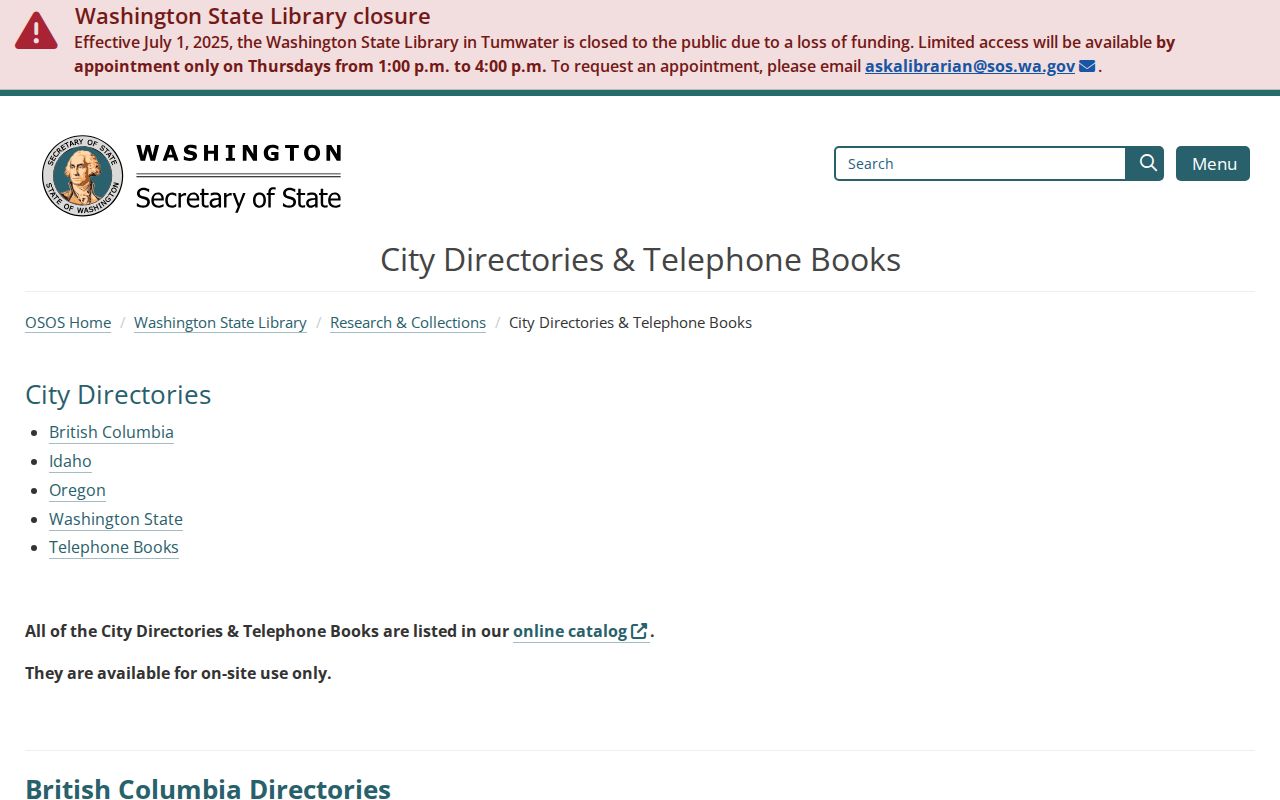
Plan the visit around the current appointment rules and have the title or catalog details ready for staff.
Read a Washington City Directory Entry
A directory entry is a dated clue, not a complete household census. In a typical alphabetical listing, a person's surname and given name or initial may be followed by occupation and residence address. A spouse or widow note may appear, and some editions use a mark for a householder or renter. The inspected Ballard page is different: it is a civic and business section, not a resident line. It records offices, fire companies, street locations, mills, churches, and other institutions, so read the page type before drawing conclusions about an individual.
| Name | Surname, given name or initial; spelling can vary by volume |
|---|---|
| Occupation | A trade or role may identify a person with a common name |
| Address | Street number and name when the listing gives one |
| Household note | A spouse or widow notation may appear in some editions |
| Symbols | Meaning differs by publisher; use that volume's front-matter key |
Do not assume a letter has the same meaning across Washington directory publishers. The front matter often defines abbreviations, household marks, and whether an address refers to residence, boarding, or a business. Old type and poor scans can also confuse letters in OCR. Check the page image against the transcript, then compare a second year or another source before treating a symbol as proof of ownership or residence.
- Criss-cross directory
- A listing arranged by street and house number, useful when the resident's name is not known.
- Householder index
- An alphabetical path to a person or household in that particular edition; its coverage depends on the publisher.
- Abbreviation key
- The volume's own guide to shortened words and marks, often printed near its opening pages.
Washington's 1893 Ballard Directory
A surviving 1893 Ballard directory page gives a compact view of a town beside Seattle's northern edge. The scanned section describes Ballard's setting at Salmon Bay, its recent platting, railway, schools, churches, and industries. It also lists municipal officers and fire companies, with locations described by street and cross street. This is local context rather than an individual name entry, but it shows why old place labels and municipal borders matter when a family story says only “Seattle.”
Open the scanned and transcribed 1893 Ballard directory page. The printed page and OCR transcript can differ, especially where older type or street abbreviations are hard to read. Follow the collection title back to the full volume and inspect the alphabetical section for a resident listing.
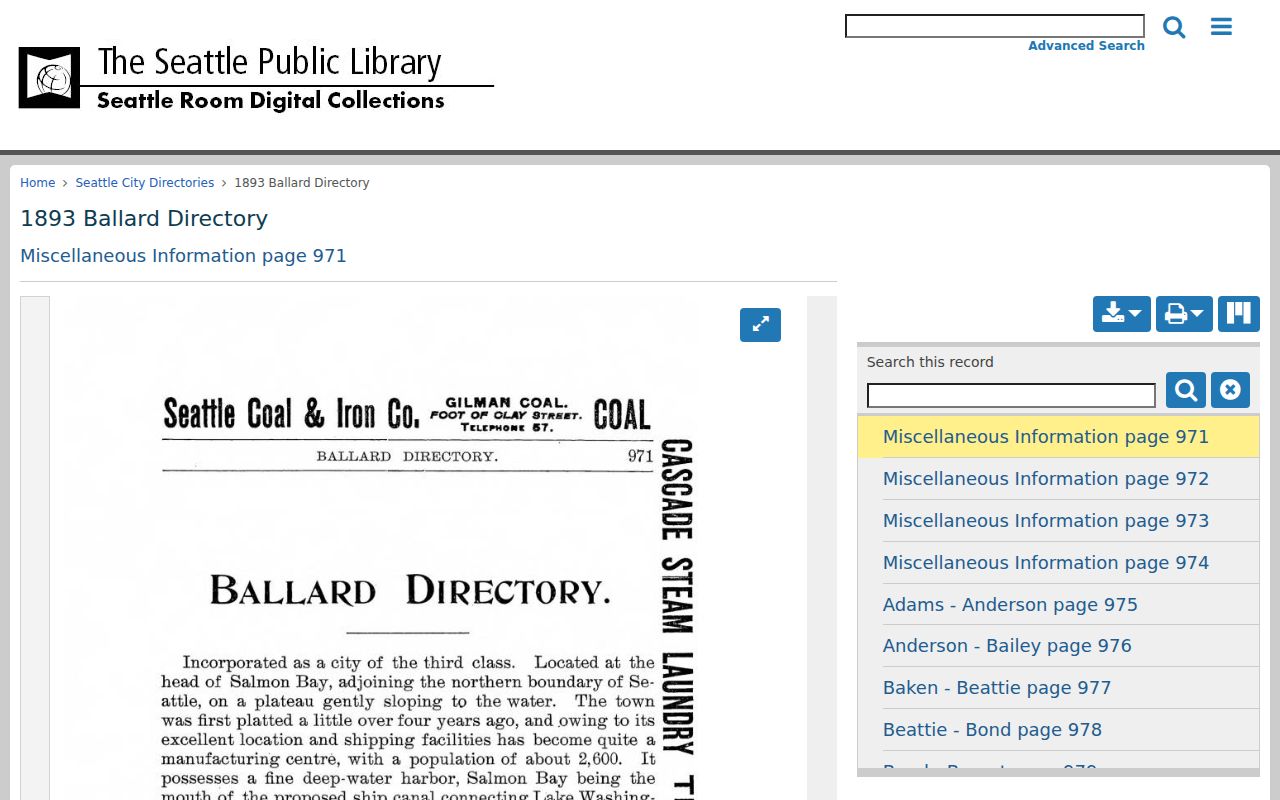
The Ballard example preserves civic and street detail that can help explain a historic household's place in the wider Seattle area.
Find Digitized Washington Directories
Digitization is selective. Seattle Public Library's ContentDM collection exposes the inspected 1893 Ballard page as an image with transcript, while the Library of Congress guide describes a much wider national directory and telephone-book landscape. The Library of Congress directory guide says its holdings are mainly from 1861 to 1960 and warns that listed year ranges can still contain gaps. Nearby towns can share one book, and the guide distinguishes alphabetical directories, street-address directories, telephone books, and reverse directories.
The Washington State Archives Digital Archives searches record series, county, and title. It is strongest for transferred government records rather than a complete index; its catalog for non-digital formats is separate. If an online search turns up nothing, check the State Library catalog, regional archive guides, and local library rather than concluding that no volume exists.
State Archives awarded $506,000 in 2025-2026 grants to 27 local-government agencies for imaging, technology, and records-management work. Newly created digital records are intended for Digital Archives or other access, so coverage can grow. A missing item today should be checked again with the county or branch holding the original. The State Archives grant announcement lists the local records-improvement program.
The State Archives repository guide identifies its regional branches and the counties they serve. Those branches hold local-government records by county, and reference staff can point to a library or historical society when the printed directory stayed outside state custody.
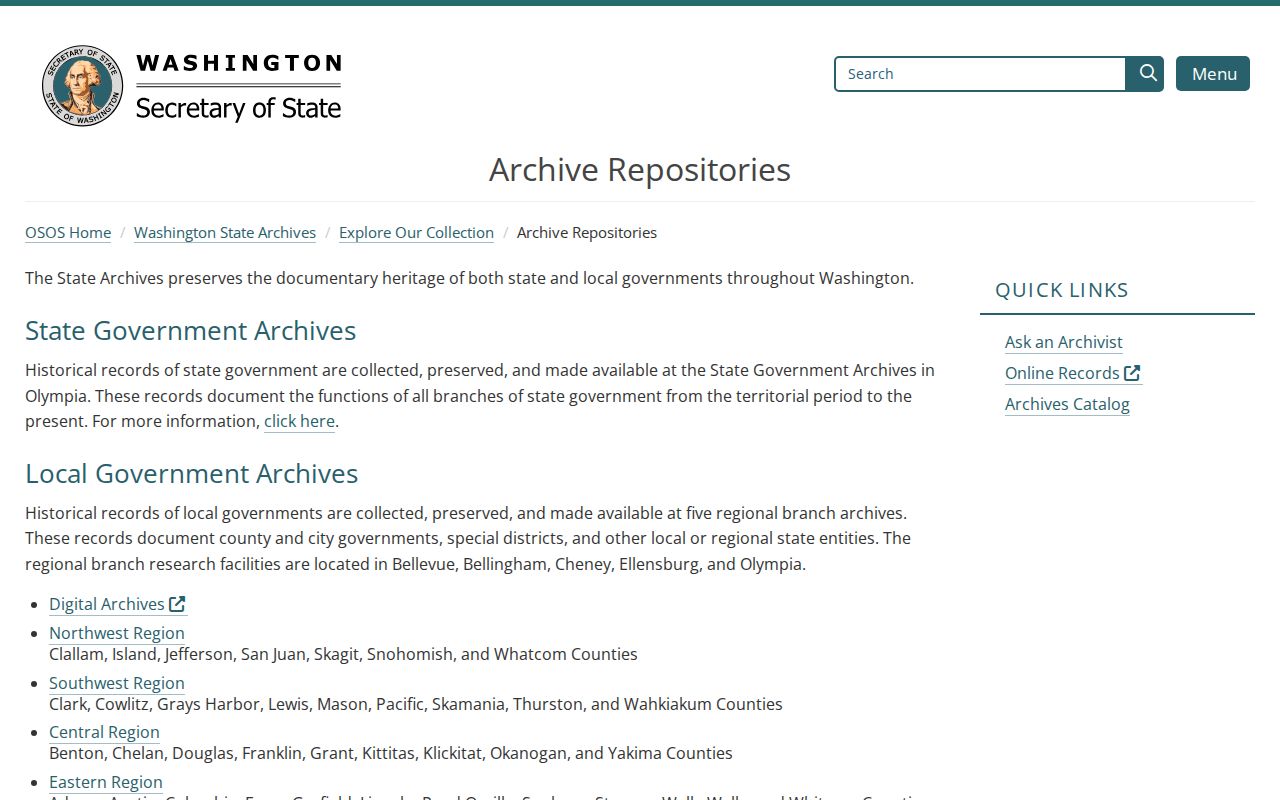
Use the branch map to route older county material to the right Washington archive before requesting copies or a staff search.
Trace Washington Resident Entries by Year
Directories can fill in the years between federal censuses, but the publication date matters. The federal census is public through 1950 under the 72-year release rule; that census opened in 2022. Directory canvassing and printing could occur at a different time, and directories more often list adults than every household member. A boarder, a person who moved midyear, or a business at the same address can account for a mismatch.
- Write down the town, county, likely year, and each known name form before searching.
- Check the alphabetical section and record the printed spelling, initial, occupation, address, and household note.
- Search a street-order section for that address, then compare the prior and following directory years.
- Pair each directory clue with the nearest census year and note the census date separately.
- Use a local newspaper, obituary, cemetery, probate, or archive record to test a move or family link.
A missing name can mean a move, a gap in publication, a changed title, an abbreviation, or simply that the person was not included. It is not, by itself, evidence of death or departure from Washington. A street renumbering, annexation, or shift from one city label to another can also move a household into a different volume. Record the exact year and source next to each clue so the chain does not look more continuous than the evidence supports.
Washington City Directory Place Names Shift
Some State Library holdings are nested under a nearby city instead of the name a family used. Ahtanum appears within a Yakima directory for 1908-1910. Algona and Auburn entries shift among Auburn and Seattle South Suburban volumes across later decades, while Alderwood Manor appears in Everett directories in the early twentieth century. Those are catalog clues, not proof of a boundary change on a particular date. Search the nearby publisher and county title when the expected town has no separate listing.
This is a useful quirk in Washington's directory shelf: the book's coverage area can be larger than its title. When a city limit, postal name, or county boundary does not match the old directory label, carry the address, plat, and county through the search. The Washington street directory route is designed for current address and parcel work; historical street entries should stay tied to the year printed in the volume.
Some publishers also combined nearby communities and changed their title or edition. A continuous surname search across one title may fail at the moment the publisher's coverage changed. Try the surrounding city's volume, county directory, and local library index before treating the gap as a break in the family's history.
Compare Washington Directories with Census
Use a directory alongside other local evidence, not as a stand-alone account of a household. Washington Digital Newspapers, Chronicling America, and local newspaper microfilm can add obituary, marriage, business, and street-change notices. County historical societies may hold photographs, maps, manuscript family papers, cemetery transcripts, business ledgers, newspaper clippings, or address files. University archives can add yearbooks, campus newspapers, oral histories, and community photographs, but there is no unified statewide alumni roster.
The Library of Congress Seattle Sanborn map set includes examples from 1884, 1888, 1893, 1905, and 1949-1950. A Sanborn map can show street names, lot outlines, building footprints, stories, materials, and use labels, but it does not name every resident or replace a deed. For a modern official record tied to a person, follow the custodian trail described in the Washington resident lookup page.
State Archives holds state, territorial, county, city, and special-district records; its regional branches are organized around local records. Churches, tribal historical offices, community newspapers, and cemetery collections can fill gaps that government volumes do not cover. Access rules vary, so ask each institution about its finding aids, permission needs, reproduction options, and whether a collection is on-site only.